Blog · By The Packaging Vista Team · June 23, 2026
Product Launch Packaging Checklist: Sample to Shelf
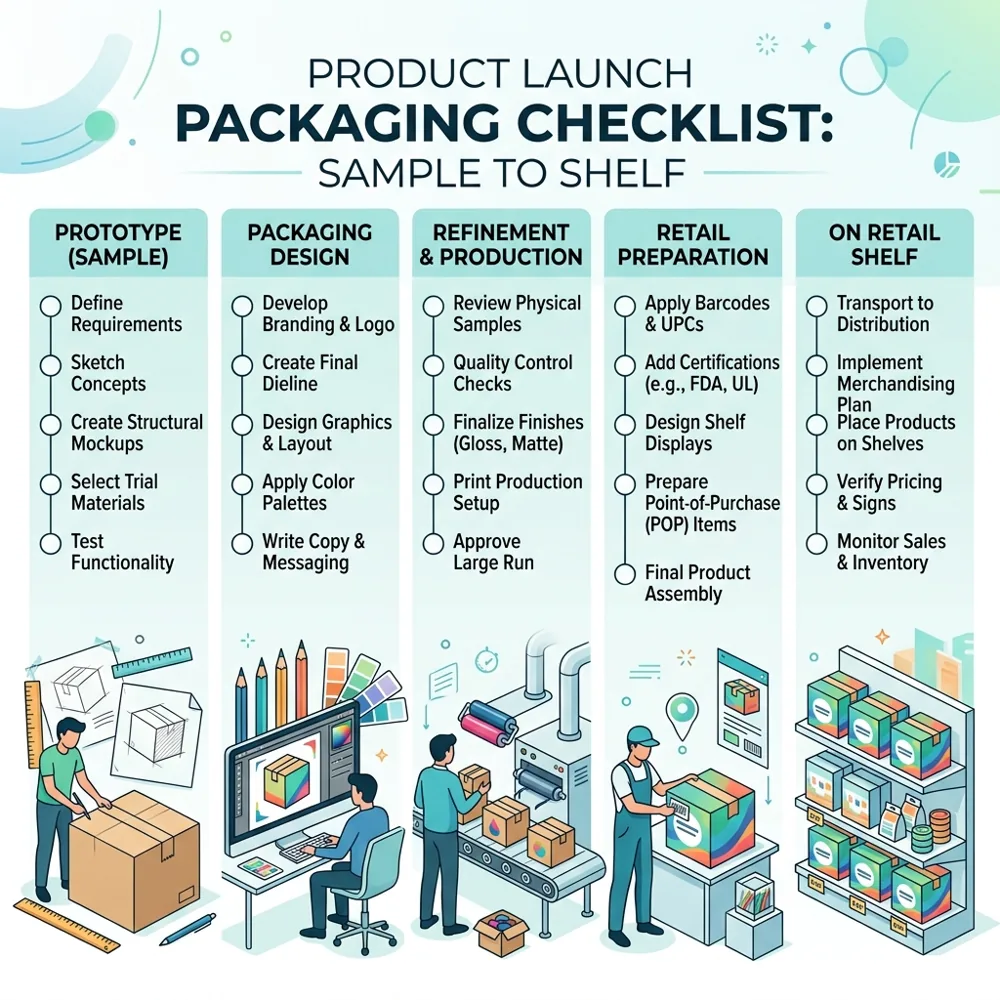
Packaging is one of the last things new brands plan. But it is one of the first things buyers judge, and it is where product branding lands physically for the first time. So build it into your launch timeline early.
This product launch packaging checklist walks you from measuring your product to holding a finished box. It gives real timing so nothing blocks your launch date. Whether you are a solo founder or a growing team, treat packaging as a project with clear steps, not an afterthought. That is what keeps custom packaging for startups on schedule and on budget.
The quick checklist
- Measure your product and pick a box style
- Choose the right material
- Approve a dieline and artwork
- Review a digital proof, then a physical sample
- Confirm MOQ, budget, and turnaround
- Place the order with buffer time before launch
Step 1 – Measure and size the box
Start with the product, not the box. Measure length, width, and height, and decide whether it ships on its own or sits on a shelf. Our guide on how to measure for a custom box walks through it, and box styles explained helps you pick mailer, tuck-end, or rigid.
Step 2 – Choose the material
Match the material to the job. Use corrugated for shipping and protection, paperboard for printed retail cartons, and rigid for premium unboxing. For a natural, sustainable look, choose kraft paper box stock or eco stocks. Compare them in our packaging materials guide.
Step 3 – Dieline and artwork
A dieline is the flat blueprint your custom printing sits on. Get a free, correctly-sized dieline before designing, and set up artwork with bleed and safe zones so nothing critical gets trimmed. See dieline templates and bleed and safe zones.
Step 4 – Proof, then physical sample
Always approve a digital proof, then a physical sample. A screen cannot show how a finish feels or how color shifts on kraft. Holding the real box is the single best way to avoid a costly full-run mistake.
Step 5 – MOQ, budget, and turnaround
Confirm the minimum order, any plate or die fees, and the production turnaround in writing. Low minimums let you launch lean and reorder on real demand. See low-MOQ packaging and packaging costs.
A realistic timeline
| Stage | Typical time |
|---|---|
| Dieline + artwork | 2–5 days |
| Digital proof + sample | 3–7 days |
| Production | 8–10 business days |
| Free US shipping | Included |
Build in a buffer. Start packaging ~4–6 weeks before launch so a revision never delays your date.
How do you align packaging with the rest of your launch?
Packaging does not happen alone. It has to land in step with your stock, photography, and store.
Coordinate the box delivery with the date your filled product is ready. So you are not folding units the night before launch. Order one extra short run or a few hand-folded samples early for product photos and social content. Polished unboxing shots often need to be live before the product itself ships.
If you sell direct-to-buyer, make sure the box sizes and weight are loaded into your shipping platform. So rates are right from day one. Think of packaging as one workstream inside the larger launch plan. That prevents the classic mistake of pretty boxes arriving after the campaign has already gone out.
How do you plan for the reorder, not just the launch?
The first run gets all the attention. But the smartest founders design with the second run in mind.
Keep your dieline and art files sorted and named so a reorder is a one-line request, not a rebuild. Leave space on the build for variants you will add later. Think new shades, flavors, sizes, or seasonal art. So the same box family stretches across your catalog.
There are no die or plate fees and the minimum stays at 100. So you can launch lean, learn from real sales, and refine a version two without writing off a warehouse of v1 boxes. That step-by-step path is exactly what low minimums are for.
How do you budget the whole packaging picture?
New founders often quote themselves only the per-box price and get surprised later. A real packaging budget includes the printed carton, any insert or void fill, an outer shipper if your retail box is not ship-ready, and the cost of a sample round before the full run.
The good news is that several common cost traps do not apply here. There are no die or plate fees. And the minimum is 100 boxes. So you are not forced into a large run to make the math work. Pricing is quote-based. It reflects your exact size, stock, and finishes rather than a one-size-fits-all sheet.
To trim cost without cutting quality, right-size the box and keep finishes simple. Those are the two biggest levers. Our guide on how to reduce packaging costs covers more. And setup fees explained shows where hidden charges usually hide.
How do you get the artwork files right the first time?
A surprising share of launch delays trace back to art that was not press-ready. Supply your design as vector art where you can. Build it on the supplied dieline. Include bleed past the trim. And keep key text inside the safe zone so nothing important is cut off.
Confirm whether your brand colors are matched as process (CMYK) or spot colors. That affects how steady they look across reorders. Getting these tech details right before you submit means the proof comes back clean. You avoid a round of edits that eats into your timeline. Our free design help is for exactly this. If you are unsure about file setup, send what you have and we will help prep it.
What are the common launch mistakes?
- Designing artwork before you have the dieline (it rarely fits).
- Skipping the physical sample to save a few days.
- Over-ordering a v1 design you will likely revise.
- Choosing an oversized box and paying dimensional weight on every parcel.
Frequently Asked Questions
How early should I start packaging for a launch?
About 4–6 weeks out. That covers dieline and artwork, a proof and physical sample, production, and a buffer for one revision.
Do I need a dieline before designing?
Yes. The dieline is the exact flat shape your artwork sits on. Designing first usually means redoing the art once the real dieline arrives.
What is a good first-order quantity?
Start low – around 100 units – so you can launch, gather feedback, and reorder or revise without sitting on a large run of a v1 design.
Should I get a physical sample?
Always. A sample shows true color, finish, and fit, and is the cheapest insurance against a costly full-run error.
What is the difference between a printed proof and a physical sample?
A proof is a flat print of your artwork you approve on screen or paper – you check color, copy, and layout. A sample is a fully assembled real box built from your files – you check fit, feel, and fold. Approve both before a full run.
When do I need a GS1 barcode or FDA label on my packaging?
A GS1-issued UPC barcode is required by most US retailers before shelf entry. FDA-regulated goods – supplements, cosmetics, and food – need the mandated label panels and drug-facts blocks. Nail these before the dieline goes to print, not after.
Can I run a small pilot batch before a full production run?
Yes. Many US shops, including us, will run 100–250 units on a digital press so you can test box-in-hand, run a pop-up, or ship to reviewers. Move to a longer offset run once the design is locked.
What happens if packaging slips and delays my launch?
You lose ad spend already booked, retailer shelf dates, and press momentum. To avoid it, sign off proofs the day they land, and build a two-week buffer into your launch calendar. A close-to-home maker is far easier to expedite.
Should launch packaging match the online mock or the shelf reality?
The shelf. A render can look great at full zoom but read as busy or washed out at arm’s length on a store shelf. Print a mounted mockup, place it at about four feet, and check the brand read before you approve.
Why is a physical sample worth the extra few days before a launch run?
A digital proof shows color and layout on a screen, but a physical sample is the only way to check how the finish feels, how color shifts on kraft, how the fold behaves with your product inside, and whether the box reads at arm’s length. A sample round costs a few days; a full-run mistake costs weeks of reprint and often the launch date itself. It is the cheapest insurance you can buy.
How do I choose the right first-order quantity for a launch?
Start at 100 units unless you have hard pre-orders or committed retail placement above that. A 100-box pilot lets you launch, gather real customer feedback, and revise the design before locking in a v2 without warehousing dead stock. Because we charge no die or plate fees, the tooling cost is the same whether you order 100 or 10,000 – you are only paying per box – so the small first run is genuinely lean, not wasteful.
What are the benefits of using a US manufacturer for a launch run?
Speed and flexibility. An 8–10 business day production run from Cheshire, CT lets you iterate one round of proofs and still hit a launch date, where an overseas run makes revisions impossible without slipping weeks. You also get direct US-hours support during proofing, no customs delays, and the option to expedite a rush order if the campaign schedule shifts – none of which is realistic with a container-scale overseas order.
How much should I budget for launch packaging beyond the per-box price?
Budget for the printed carton, any insert or void fill, an outer shipper if the retail box is not ship-ready, and one sample round. Skip the die and plate fees – we charge none – and skip forced high MOQs; ours is 100. Free design help, free dieline, free 3D mockup, and free US shipping mean the quote you see is the landed cost.
Right-size the box and keep finishes simple to trim spend without cutting quality.
Launching soon? Request a free quote and we will size the box, build a free dieline, and send a sample so your packaging is ready before your launch date. Have questions first? Contact our team.