Blog · By The Packaging Vista Team · June 23, 2026
Luxury Packaging: The Complete Guide to Premium Custom Boxes
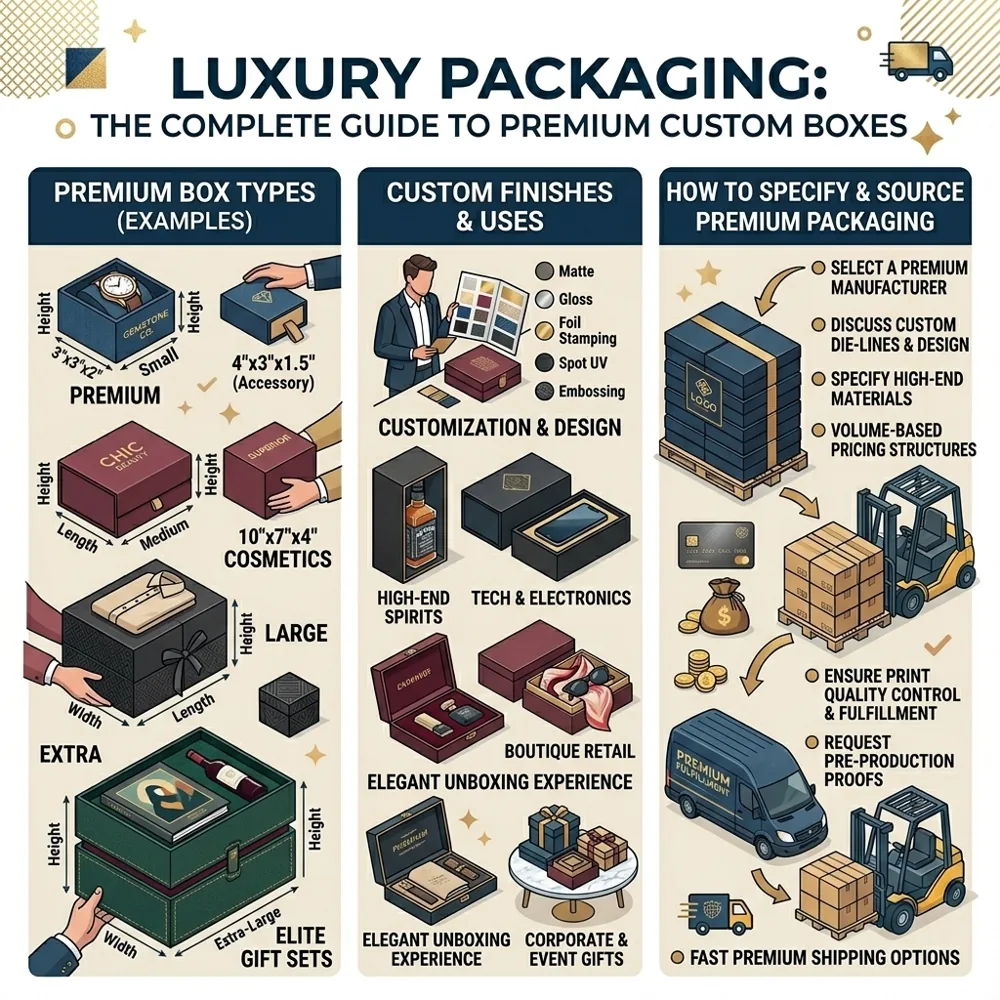
Luxury packaging is not one stock or one finish. It is a set of chosen picks that together make a product feel worth more.
Weight, shape, finish, color restraint, and the unboxing order all signal luxe. This full guide breaks down each lever of luxury packaging design. So you can make a box feel high-end on purpose, and decide where the spend on custom printing and finishing is worth it. Everything here is on our custom printed boxes for any product with no die, plate, or setup fees.
Key takeaways
- Weight & structure – rigid and magnetic boxes feel substantial.
- Finish – soft-touch, foil, and emboss do the heavy lifting.
- Restraint – one bold finish beats five competing ones.
- Unboxing – inserts, reveal, and tactile detail complete the feel.
What makes packaging feel "luxury"?
Luxe is a view built from real cues. Five levers do most of the work. Luxury comes from blending them, not from maxing out any one:
- Weight and rigidity – a box that feels solid and does not flex reads as expensive.
- Tactile finish – how it feels in the hand (soft-touch, texture) registers before the eye even reads the logo.
- Considered color – restrained, confident palettes feel more premium than busy, loud ones.
- A deliberate open – a magnetic snap or a slow drawer pull turns opening into a moment.
- Fit and finish – a snug insert and clean edges show care; rattle and gaps cheapen instantly.
Which structures read premium?
The build sets the tone before a buyer sees the product. The shapes that read luxe:
- Rigid (set-up) boxes – thick chipboard wrapped in printed paper; the heavyweight, non-collapsible feel of luxury goods. See our rigid setup boxes for luxury goods and the in-depth rigid boxes guide.
- Magnetic-closure boxes – a concealed magnet gives a satisfying soft-close snap and a frameless, gift-ready open. See magnetic closure boxes for premium gifts.
- Drawer / slide-out boxes – a theatrical reveal as the inner tray slides out.
- Two-piece (lid & base) and book-style – classic, sturdy formats for gifting and keepsakes. See two-piece gift boxes for keepsakes and jewelry boxes for rings and watches.
Which materials feel premium?
Stock is the base of feel. Rigid chipboard gives the most solid weight. Heavy SBS with a soft-touch laminate gives a luxe feel at lower cost than rigid. Specialty wraps and textured stocks add feel.
Even kraft can read luxe when paired with a quiet design and foil. Match the stock to the price point. Our packaging materials guide compares each option.
Which finishes signal luxe?
Finishes are where a printed box turns luxe. They are put on after printing:
- Soft-touch lamination – a velvety, matte feel that is the foundation of most premium boxes.
- Foil stamping – gold, silver, rose-gold, or holographic shine on a logo or border.
- Embossing / debossing – a raised or recessed impression you can feel.
- Spot UV – glossy raised detail against a matte field for contrast.
For the full menu, see our box finishes guide; to choose between the two most popular accents, see spot UV vs foil. How these print depends on method and stock – see our custom box printing guide.
How do you design the unboxing?
For luxe and gift products, opening the box is part of the product. Build a planned order. A magnetic or drawer open. A branded tissue or printed liner. Then a fitted foam, EVA, or molded insert that presents the product like it is on display.
Ribbon pulls, thumb-notches, and a thank-you card add moments. A clean, well-paced reveal is what gets a box kept, reused, and posted – turning packs into earned reach.
Why does restraint read as luxe?
The top luxury slip is doing too much. Stacking five finishes, loud color, and busy art reads as trying hard, not costly.
The luxe move is restraint. One bold color. Room to breathe. A single hero finish – a foil logo on a soft-touch box – done cleanly. Let the stock and shape carry the rest.
Which luxe build fits each industry?
| Industry | Go-to premium build |
|---|---|
| Prestige beauty | Rigid or magnetic box, soft-touch + foil – see premium cosmetic boxes for beauty brands and our luxury cosmetic packaging guide |
| Jewelry & watches | Rigid or drawer box with satin insert – see rigid jewelry boxes with satin inserts |
| Spirits & gifting | Two-piece or magnetic gift box, emboss + foil – see magnetic gift boxes for spirits |
| Electronics & tech | Magnetic book-style with fitted foam tray |
| Subscription & DTC | Magnetic mailer with branded tissue and insert |
Is luxury packaging worth it?
Luxe packaging costs more per unit. Rigid is the priciest because it is thick and hand-built. But for the right product it pays back.
It raises value in the buyer’s eye. That backs a higher price. It drives share-worthy unboxing. And it gets kept on a shelf, not tossed. So your brand stays in view. Spend where it shows. A soft-touch SBS box with one foil hit can feel 90% as luxe as rigid at far less. See our packaging cost guide for what drives price.
What mistakes should you avoid?
- Too many finishes. Competing effects cancel out; pick one hero finish.
- A flimsy box with a fancy logo. If it flexes or rattles, no foil will save it – weight and fit come first.
- Loud color and busy art. Restraint reads as confidence; clutter reads as cheap.
- A loose insert. A product that shifts inside undoes the premium feel instantly.
- Over-speccing rigid. Many premium looks are achievable with heavy SBS + soft-touch at lower cost.
What are the expert tips?
- Lead with weight and fit; add finishes second.
- Choose one hero finish (usually soft-touch as the base + foil as the accent).
- Design the open, not just the outside – the reveal is the memory.
- Order a physical sample; premium is felt, and screens cannot show texture.
Frequently Asked Questions
What makes packaging look and feel luxury?
A mix of weight and stiffness, a touch-first finish like soft-touch, quiet color, a planned open like a magnetic snap, and a snug insert. Luxury comes from blending these cues cleanly, not from stacking effects.
Do I need a rigid box for a luxe look?
Not always. Rigid gives the most solid feel. But a heavy SBS box with soft-touch and a single foil touch can feel nearly as luxe at a lot less. Match the build to your price point.
Which finish gives the most premium feel for the cost?
Soft-touch lamination is the highest-impact base finish, and a single foil-stamped logo on top of it is the most cost-effective premium combination. Adding more finishes rarely improves the feel.
Is luxury packaging worth the extra cost?
For products where the buyer view and the unboxing matter, yes. It backs a higher price. It drives share-worthy unboxing content. And it gets kept rather than tossed. Spend where it shows. Keep the rest simple.
What is the minimum order for luxury boxes?
The minimum is just 100 boxes, with no die, plate, or setup fees, so you can launch a premium product or run a limited edition without committing to large quantities.
How do I choose the right luxury structure for my product?
Match structure to the buying moment and product value. Prestige beauty and fine jewelry earn rigid or magnetic boxes with satin or fitted inserts. Spirits and gifting suit two-piece or magnetic gift boxes with emboss and foil. Electronics work with magnetic book-style boxes and fitted foam trays.
Subscription and DTC luxe brands often use magnetic mailers with branded tissue. If in doubt, start with heavy SBS + soft-touch + a foil accent – it delivers 90% of a rigid feel at far lower cost.
What are the benefits of luxury packaging beyond looking expensive?
Three big commercial ones: it lifts perceived product value so you can price higher; it drives share-worthy unboxing content that earns organic social reach; and it gets kept on a shelf or reused rather than tossed, so the brand stays in the buyer’s home.
It also often reduces returns because the arrival experience matches the price paid. Restraint reads as confidence – stacking effects reads as trying too hard and cancels the luxe signal.
What is the difference between a luxury rigid box and a premium folding carton?
Rigid is built from thick greyboard (usually 1200-2000gsm) wrapped in printed paper – heavy, hand-built, arrives pre-formed, feels solid and expensive. Premium folding cartons use heavy SBS (24pt+) with soft-touch lamination and foil – still feels premium but ships flat, costs less, and assembles at fill.
Rigid wins on absolute luxe feel; folding cartons win on cost and shipping efficiency. Many brands run rigid for hero SKUs and folding cartons for everyday retail.
How much does luxury packaging cost compared to standard folding cartons?
Rigid magnetic boxes typically cost several times a comparable folding carton because greyboard is thicker and the box is hand-built rather than shipped flat. Soft-touch SBS with foil costs modestly more than standard folding cartons. Since we do not charge die, plate, or setup fees, tooling is not the barrier at 100 units – the cost driver is stock and hand-assembly time.
Rigid pays back where perceived value and unboxing content matter; skip when the box is just protection.
Which luxury build is best for a first premium product launch?
Heavy SBS folding carton (24pt+) with a soft-touch matte lamination and a small foil-stamped logo – it delivers about 90% of the rigid box feel at roughly a third of the cost, and at our 100-box minimum it fits a launch budget. Move to full rigid or magnetic-close only for hero SKUs where the unboxing is the marketing (PR mailers, gift editions, launch drops).
Do not over-spec every SKU into rigid.
Build your luxury packaging
Ready to order? Browse our custom luxury packaging for premium products. Tell us your product, price point, and the feel you want. We will pick the shape, stock, and finishes, build a free dieline and 3D mockup, and match your brand color. Request a free quote or contact our team.