Blog · By The Packaging Vista Team · June 20, 2026
Standard Box Sizes: A Reference for Common Packaging
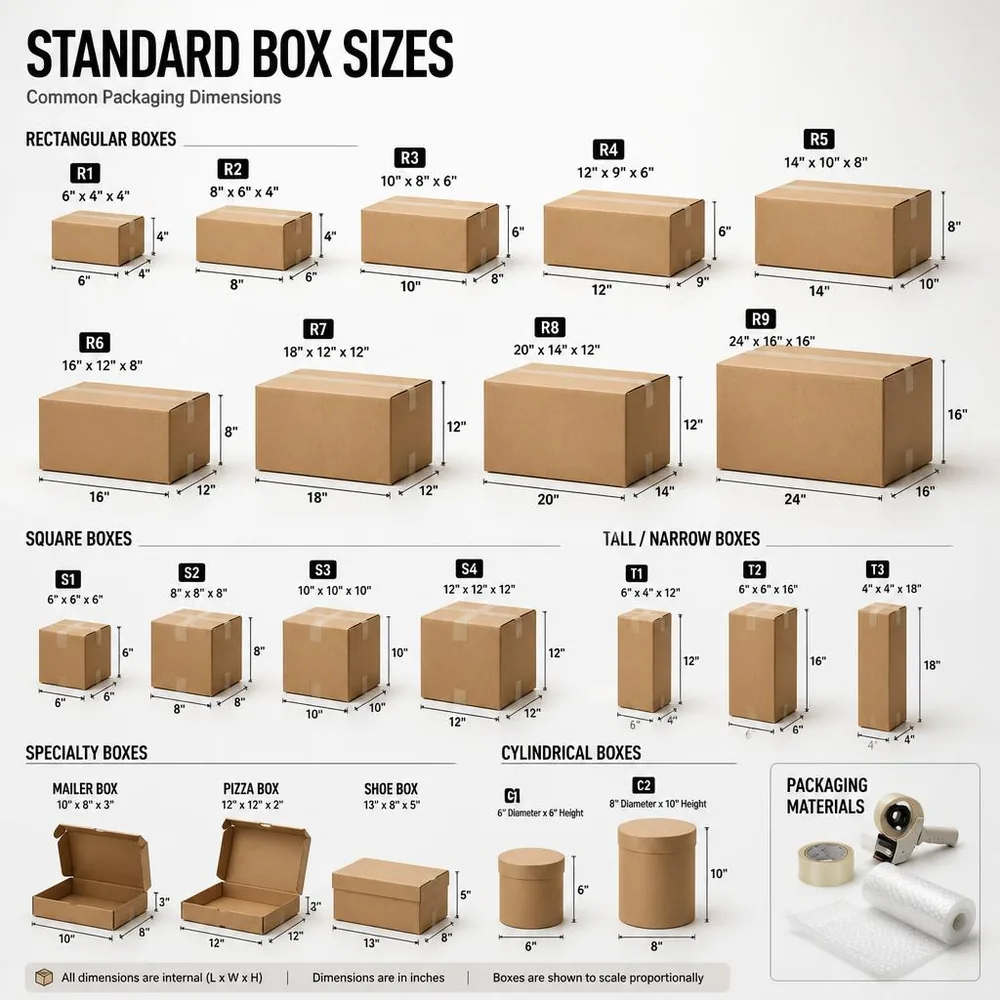
There is no single "standard" box size. But common sizes by box type and product are a useful start.
Use this list to get in the right range for your shipping packaging or retail carton. Then tune it to your exact product. Every size below is given as length × width × height (L × W × H), in inches. That is the format UPS, FedEx, and USPS use. Figures are typical inside sizes. The outside runs about 1/4 to 1/2 inch larger per side once you add wall thickness.
Key takeaways
- Starting points, not rules: your product should set the size – these are common ballparks.
- Always L × W × H, in inches; interior and exterior differ by about 1/4 to 1/2 inch per side.
- Custom beats stock: we build custom printed boxes to any exact size with no die or setup fees and a 100-box minimum.
- Deep dives: mailer, cake, and lip gloss box sizes.
How box sizes are measured
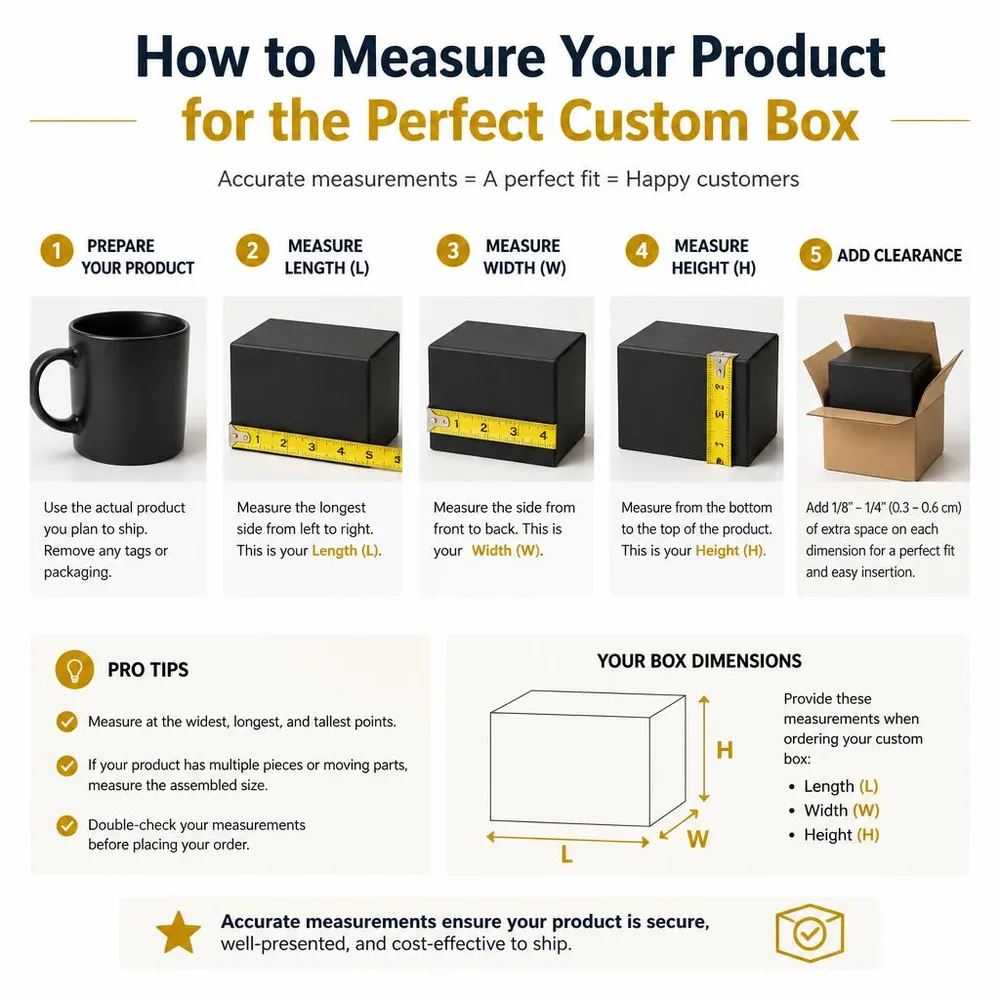
Boxes are listed as L × W × H. Length is the longer side of the opening. Width is the shorter side. Height is the depth.
Suppliers quote inside sizes (the space your product takes). Carriers bill on outside sizes, which add the board thickness – about 1/4 inch per side for folding cartons and up to 1/2 inch for corrugated. Measure your product, add a bit of room, and use the tables below as a guide. Our how to measure guide walks through it step by step.
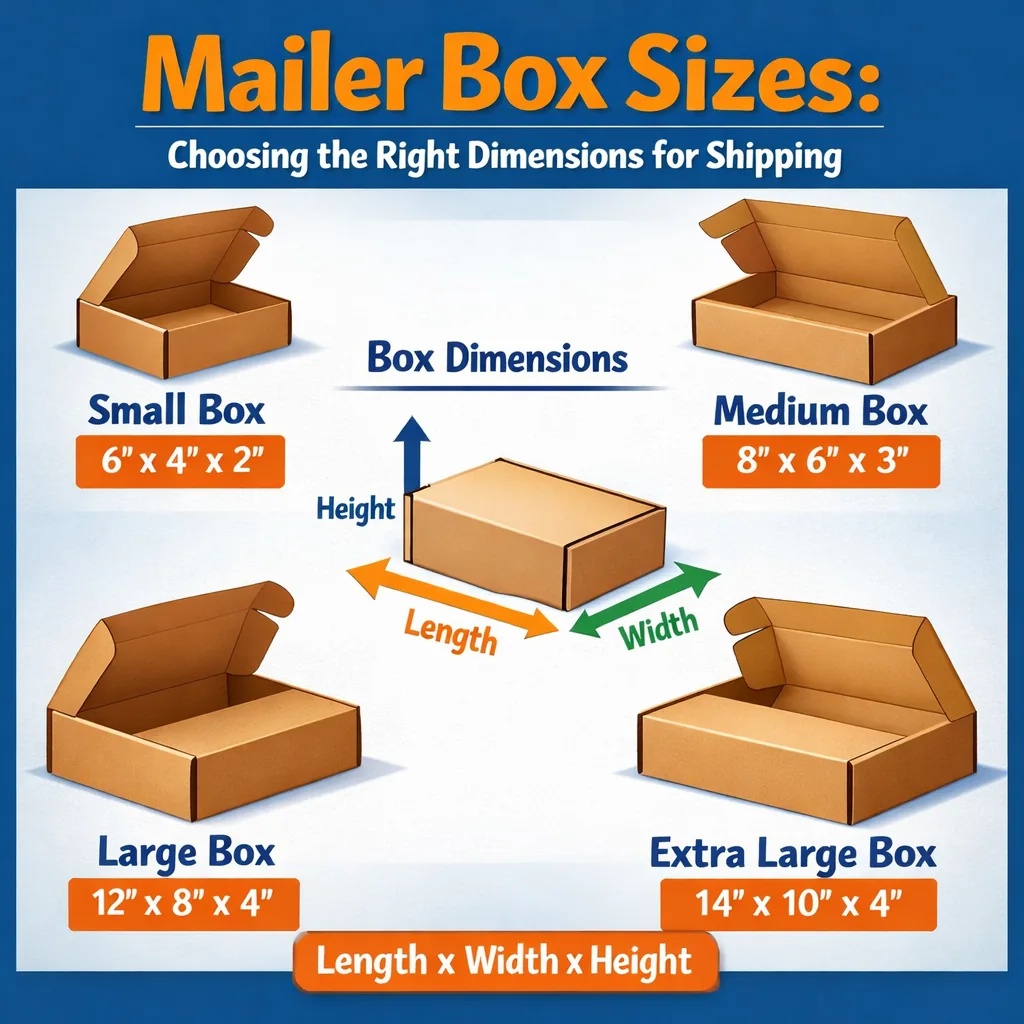
Standard mailer box sizes
Common e-commerce mailer box sizes by tier:
| Tier | Typical sizes (L × W × H, in) | Common use |
|---|---|---|
| Small | 6 × 4 × 2, 8 × 6 × 2, 9 × 6 × 2 | Jewelry, cosmetics, accessories, candles |
| Medium | 9 × 6 × 3, 10 × 8 × 3, 12 × 9 × 4 | Apparel, books, small electronics |
| Large | 12 × 9 × 6, 14 × 10 × 4, 16 × 12 × 8 | Bundles, bulkier goods, subscription boxes |
Standard shipping and corrugated box sizes
Common corrugated shipping cartons (regular slotted carton / RSC):
| Type | Typical sizes (L × W × H, in) |
|---|---|
| Cube | 6 × 6 × 6, 8 × 8 × 8, 10 × 10 × 10, 12 × 12 × 12 |
| Small | 8 × 6 × 4, 10 × 8 × 6 |
| Medium | 12 × 9 × 6, 16 × 12 × 8, 18 × 14 × 12 |
| Large | 20 × 16 × 12, 24 × 18 × 18 |
Rigid and gift box sizes
Rigid (setup) boxes are built to spec, but common two-piece and gift footprints include:
| Style | Typical footprint (L × W × H, in) |
|---|---|
| Small gift / jewelry | 5 × 5 × 2, 6 × 6 × 2 |
| Medium two-piece | 8 × 8 × 3, 10 × 8 × 3 |
| Magnetic closure | 9 × 6 × 2, 12 × 9 × 3 |
| Apparel / large | 12 × 12 × 4, 15 × 11 × 4 |
Folding carton and small product box sizes
Small retail folding cartons for cosmetics, supplements, and packaged goods:
| Product | Typical size (L × W × H, in) |
|---|---|
| Slim (lip gloss, mascara, pencil) | 1 × 1 × 3 to 1.5 × 1.5 × 4 |
| Skincare jar / cream | 2 × 2 × 2 to 3 × 3 × 3 |
| Supplement bottle | 2 × 2 × 4 to 2.5 × 2.5 × 5 |
| Soap bar | 3.5 × 2.5 × 1 |
Plain cardboard box sizes
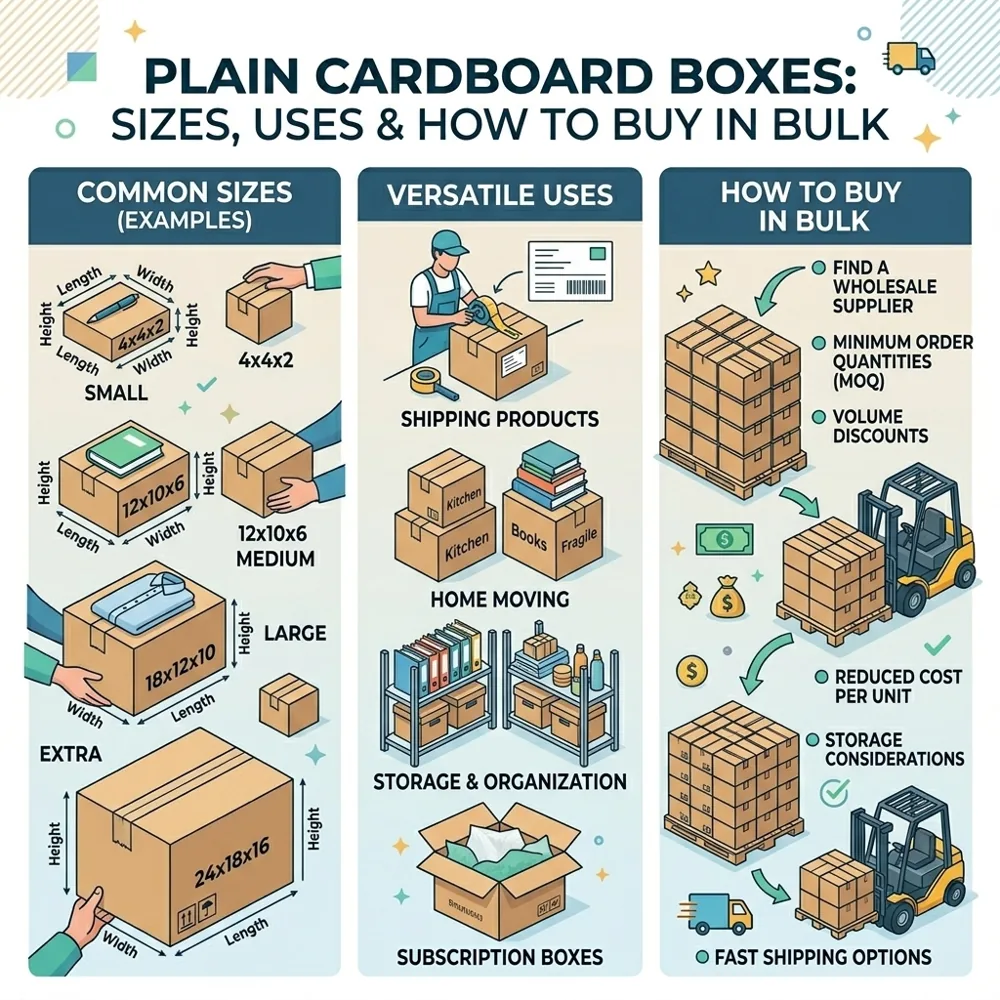
Plain cardboard shipping and storage boxes – unprinted kraft or corrugated boxes for shipping, moving, and storage – follow the most set size rules of any box type. That is because they are sold in stock tiers, not built to a product.
The standard small / medium / large / extra-large cube path below covers most plain cardboard box orders:
| Tier | Typical size (L × W × H, in) | Common use |
|---|---|---|
| Extra small | 4 × 4 × 4, 6 × 4 × 4 | Small parts, samples, hardware |
| Small | 8 × 6 × 4, 10 × 8 × 6, 12 × 9 × 6 | Books, mugs, single products |
| Medium | 12 × 12 × 12, 14 × 12 × 12, 16 × 12 × 12 | Kitchenware, toys, general moving |
| Large | 18 × 18 × 16, 20 × 20 × 15 | Bedding, lamps, lighter bulk goods |
| Extra large | 24 × 18 × 18, 24 × 24 × 24 | Pillows, bulky or multi-item shipments |
Plain boxes ship and store flat. So the "right" size is the stock tier just above your product, with room for cushion. If your product falls between tiers, a custom-sized box with no die fee or setup fee cuts the wasted space – and the dim-weight fee that comes with it. See our plain cardboard boxes page for stock, wall, and MOQ details.
Sizes by product (detailed guides)
Some categories have well-known conventions – see the dedicated size guides:
- Mailer box sizes for e-commerce shipping
- Cake box sizes for bakeries
- Lip gloss box sizes & dimensions
- Bath bomb box dimensions
How much clearance to add
The gap between your product and the box walls makes packing easy and guards the goods. Too much gap wastes stock and invites rattling.
For rigid retail items in a folding carton, about 1/8 to 1/4 inch of total gap is enough. Just enough to insert and remove the item with ease. For fragile or shipped goods, leave room for cushion: a 1/2 inch to 1 inch buffer on each side for void fill or an insert.
If you use a fitted insert, size the outer box around the insert, not the bare product. When not sure, prototype with the real item before you commit to a run.
Why custom usually beats stock
A stock size that is "close enough" almost always means wasted space, more void fill, and higher shipping cost. Dimensional weight pricing punishes big boxes.
We build custom printed boxes to your exact sizes with no die or plate fees and a 100-box minimum. So there is little reason to settle for a stock size that just fits. A right-sized box also looks more polished on arrival, photographs better for unboxing, and cuts the cushion you have to buy and store. Our dimensional weight guide shows how a big box quietly bloats freight cost.
Frequently asked questions
Is box size interior or exterior?
Suppliers quote inside sizes – the usable space for your product. Carriers bill on outside sizes, which add the board thickness (about 1/4 inch per side for cartons, up to 1/2 inch for corrugated). Always check which one a quote uses.
How do I read L × W × H?
Length is the longer side of the box opening. Width is the shorter side. Height is the depth from opening to bottom. This is the order UPS, FedEx, and USPS use. So quoting it the same way avoids mix-ups.
Can I order a non-standard size?
Yes. We build to any exact sizes you need, with no die or setup fee and a 100-box minimum. So a custom size that fits your product just right costs no more in tooling than a stock size.
What is a standard box size?
There isn’t a single standard. Standard box sizes are common stock tiers (small, medium, large, extra-large) sold by paper mills and carriers, quoted L × W × H in inches. Cubes like 6″ × 6″ × 6″ and mailers like 9″ × 6″ × 3″ are the most common. They’re starting points – your product should still set the final size.
How do I choose the right box size for my product?
Measure the product L × W × H, add 1/8 to 1/4 inch of gap for rigid retail items in a folding carton, or 1/2 to 1 inch on each side for fragile or shipped goods needing void fill. Pick the closest table tier above your product, or spec a custom size. Prototype with the real item before you commit to a run.
What is the difference between interior and exterior box dimensions?
Interior is the usable space your product sits in – what suppliers quote. Exterior adds the board thickness (about 1/4 inch per side for folding cartons, up to 1/2 inch for corrugated) and is what UPS, FedEx, and USPS bill on for dimensional weight. A 12 × 9 × 6 interior can measure closer to 12.5 × 9.5 × 6.5 outside.
Which box size is best for keeping shipping costs down?
The smallest one your product safely fits in. Dimensional weight pricing charges by volume, so a box that’s 2 inches too big in each dimension can push you into a higher freight tier even if the product is light. A right-sized custom box – no die or setup fee at Packaging Vista – usually beats a stock tier that’s "close enough."
Get a box sized to your product
Tell us your product or rough sizes. We will build a free dieline sized to fit. Free design help. 8–10 day turnaround. Start with our measuring guide, then request your free quote or contact our team.